- When you can use Present Perfect
- Time markers in Present Perfect
- How to build Present Perfect
- Past Participle of the verbs (V3/ed)
- Past Participle of Regular Verbs (ed)
- Past Participle of some Irregular Verbs
- already, just, yet in Present Perfect
- since and for in Present Perfect
When you can use Present Perfect
-
You use Present Perfect for finished actions which have a present result. In Present Perfect the result of an action is more important than the time when the action happened.If you have a specific time when the action was done (e.g. yesterday, the day before yesterday, last week/month/year, an hour ago, two days ago, on Tuesday, in May, in 1995, etc, or questions with when), use Past Simple instead of Present Perfect.
- We have bought a house. /present result — we have a house/
- She has painted the wall. /present result — the walls are painted/
- I have washed all the dishes. /present result — all the dishes are washed/
- Matthew has crashed his computer. /present result — Matthew’s computer is broken/
-
You use Present Perfect for actions or states which started in the past and continue up to present.
- Emma has been a teacher for over a year now. /Emma is still a teacher — action is not finished/
- They have worked in this company for 2 years. /They still work in this company — action is not finished/
- My family has lived here for many years. /My family still lives here — action is not finished/
-
You use Present Perfect to say about your personal experience.
- They have never eaten redfish.
- I have visited 31 countries so far.
- She has lost 7 kilos.
-
You use Present Perfect with superlatives.
- It’s the most breathtaking view I have ever seen. /the most breathtaking — superlative/
- It’s the most disgusting dish he has ever eaten. /the most disgusting — superlative/
- It’s the most expensive dress she has ever bought. /the most expensive — superlative/
-
You use Present Perfect to say or ask how many/much you have done so far.
- How many blog posts have you written this month?
- John has read 12 books this year.
- How much coffee has she drunk this morning?
-
You use Present Perfect to say or ask how often you have done something up to now.
- We have spoken to each other twice this month. /how often — twice this month/
- I have been to the gym three times this week. /how often — three times this week/
- This year he has changed his job twice. /how often — twice this year/
Time markers in Present Perfect
- just
- yet
- already
- ever
- never
- since
- for
- so far
- recently
- today
- this week/month
- year
- up to now
- up to present
- lately
How to build Present Perfect
|
+
|
I/we/you/they + have + V3/ed
He/she/it + has + V3/ed
|
|
−
|
I/we/you/they + haven’t + V3/ed
He/she/it + hasn’t + V3/ed
|
|
?
|
Have + I/we/you/they + V3/ed
Has + he/she/it + V3/ed
|
|
Wh-?
|
Wh + have + I/we/you/they + V3/ed
Wh + has + he/she/it + V3/ed
|
Practice!
- Present Perfect — Positive — Exercise 1
- Present Perfect — Positive — Exercise 2
- Present Perfect — Positive — Say what you have already done — Exercise 1
- Present Perfect — Positive — Say what you have already done — Exercise 2
- Present Perfect — Negative — Exercise 1
- Present Perfect — Negative — Exercise 2
- Present Perfect — Negative — Exercise 3
- Present Perfect — ever/never
- Present Perfect — Yes/No question
- Present Perfect — Short answer
- Present Perfect — Wh-question — Exercise 1
- Present Perfect — Put the Wh-question to the word/phrase in bold
- Present Perfect — Mixed
Past Participle of the verbs (V3/ed)
When you build Present Perfect, you should use Past Participle (V3/ed) of the verb.
|
Past Participle of the verb
|
|
|
Regular
Irregular
Add ending -ed:
Use its third form
You need to study third form of the verbs as irregular verbs have special forms in Past Participle:
|
|
Past Participle of Regular Verbs (ed)
|
verbs ending with a consonant + Y ➔
Y + ied
|
|
|
verbs ending with a vowel (a, o, e, u, i) + y
➔ + ed
|
|
|
one-syllable verbs with a vowel + one consonant
in the end ➔ double the last consonant + ed
|
work — worked (don’t double “k”, because there are two consonants after the vowel)
|
|
one-syllable verb with a vowel + X
in the end ➔ DO NOT double X.
Just add -ed
|
|
|
if the two-syllable verb with a vowel + consonant
in the end has stress on the
second syllable ➔
double the last consonant + ed
|
These verbs have:
|
|
if the two-syllable verb with a vowel + consonant
in the end has stress on the
first syllable ➔
DO NOT double the last consonant.
Just add -ed
|
These verbs have:
|
|
verbs ending with e ➔
add only -d
|
|
|
verbs ending with c ➔
add k + ed
|
|
|
verbs ending with L
|
|
|
all other verbs
(not mentioned above) ➔
just add -ed
|
|
Past Participle of some Irregular Verbs
| Verb | Past Simple | Past Participle |
|---|---|---|
| be | was/were | been |
| become | became | become |
| begin | began | begun |
| break | broke | broken |
| bring | brought | brought |
| buy | bought | bought |
| choose | chose | chosen |
| come | came | come |
| cost | cost | cost |
| do | did | done |
| drink | drank | drunk |
| drive | drove | driven |
| eat | ate | eaten |
| feel | felt | felt |
| find | found | found |
| fly | flew | flown |
| forget | forgot | forgotten |
| get | got | got |
| give | gave | given |
| go | went | gone |
| have | had | had |
| hear | heard | heard |
| keep | kept | kept |
| know | knew | known |
| leave | left | left |
| lose | lost | lost |
| make | made | made |
| meet | met | met |
| pay | paid | paid |
| put | put | put |
| read | read | read |
| run | run | run |
| say | said | said |
| see | saw | seen |
| sell | sold | sold |
| send | sent | sent |
| sing | sang | sung |
| sit | sat | sat |
| sleep | slept | slept |
| speak | spoke | spoken |
| spend | spent | spent |
| stand | stood | stood |
| swim | swam | swum |
| take | took | taken |
| teach | taught | taught |
| tell | told | told |
| think | thought | thought |
| understand | understood | understood |
| wear | wore | worn |
| write | wrote | written |
already, just, yet in Present Perfect
|
ALREADY
|
|
Meaning
before the present time; earlier
Type of sentence
affirmative (+) and question (?)
Position in a sentence
|
|
JUST
|
|
Meaning
very recently; a short time ago
Type of sentence
affirmative (+)
Position in a sentence
(+)
between have/has and the main verb
|
|
YET
|
|
Meaning
something has not been done or finished until the present time
Type of sentence
negative (−) and question (?)
Position in a sentence
|
Practice!
since and for in Present Perfect
Use since and
for to say
how long.
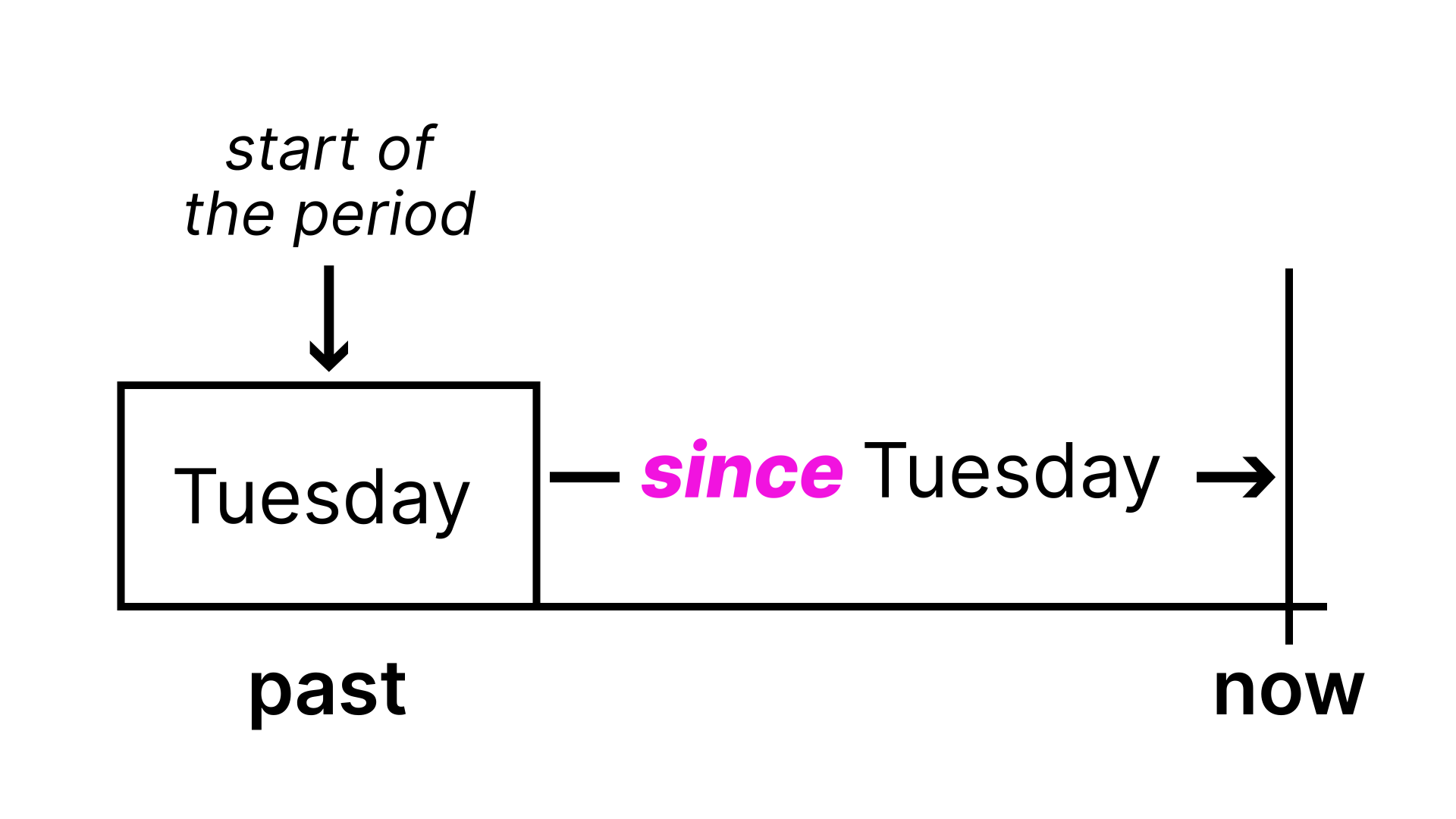
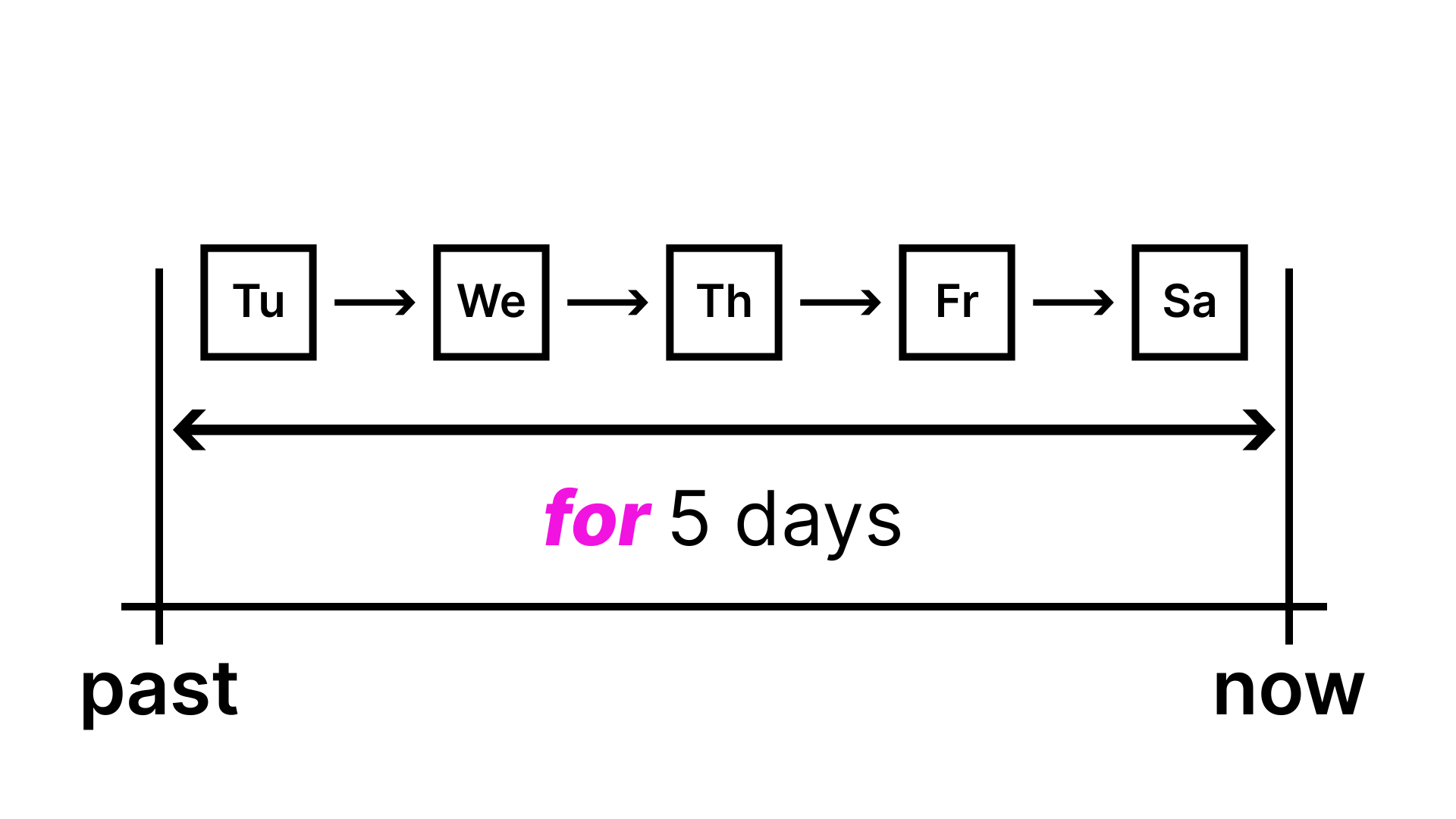
Kevin is on a business trip in Canada. He is in Canada now.
He arrived in Canada on Tuesday. Today is Saturday.
How long had Kevin been in Canada?
- He has been in Canada ➔ since Tuesday.
- He has been in Canada ➔ for 5 days.
| since | for |
|---|---|
|
Use since + the start of the period
(since Tuesday)
Use for + a period of time
(for 5 days)
|
|
Practice!